A Dose Of Inspiration: Quotes By Writers, Actors, and More to Inspire Travel and Adventure

by Lindsay Shapka in , ,


“Never go on trips with anyone you do not love.”
— Ernest Hemingway

“But I am a born pilgrim. Even when I am feeling really lazy or I’m missing home, I need take only one step to be carried away by the excitement of the journey... I realize that I will never reach my goal by staying in the same place all the time. I can speak to my soul only when the two of us are off exploring deserts or cities or mountains or roads. ”
— from Aleph by Paulo Coelho

Read More

What's The Difference Between Ice Cream And Gelato?

by Lindsay Shapka in , ,


Colorful mounds of sweet iced goodness sit in glass-topped coolers, enticing those walking by to stop and purchase a scoop (or two) of melt-in-your-mouth flavors like lemon, Nutella, and blood-orange creamsicle.

Nothing beats gelato.

Read More

Travel Tip: Don't Sit Down When Dining In Rome, It Will Cost More!

by Lindsay Shapka in , , ,


An article published in The Telegraph a few years ago told the tale of a few tourists in Rome who kicked up a stink when they were charged 42 Euros for two ice creams and a bottle of water in a cafe. Thinking that they were being scammed, they even went so far as to get the police involved.

Read More

Macarons! The History of These Beautiful French Treats

by Lindsay Shapka in , , , ,


The first time that I ever saw a macaron was 14 years ago in Paris and I wasn't really sure what I was looking at.

Why?

Well, these tasty treats (which hadn't made it into the cafes and bakeries at home yet) are very brightly colored, often neon green, pink, yellow, and even blue.

Read More

To Kiss Or Not To Kiss? Your Guide To Cheek Kissing Etiquette

by Lindsay Shapka in , , ,


Social greetings can be hard enough to navigate when in a different country (do you shake hands, hug, bow... ) but when social kissing gets thrown into the mix (especially when kissing is not the norm where you come from) things can get VERY confusing.

When do you kiss?

How many kisses?

Left cheek? Right cheek? Both? Ahhhh!!!!

(You can see why social kissing can lead to serious social anxiety.)

Oh, and to make matters worse, not only are there different rules in every country, there are different rules in every city in every country... sigh...

Feeling overwhelmed? Here are a few simple, general rules to help you out:

  • Don't kiss people you don't know unless you are introduced to them in a social environment.

  • It is usually right cheek first, but be prepared to change direction at the last minute. (NOTE: A sense of humor is useful for an accidental meet-in-the-middle moment)

  • Sound effects, air kissing, and leaving behind saliva are to be avoided AT ALL COSTS!

  • Don't linger and keep your hands WELL above the waist.

  • When in doubt, let the other person take the lead.

Cheek kissing is very common in most of Europe, the Mediterranean, Latin America, the Middle East, Quebec (in Canada), and in parts of the US. Here are a few places you will encounter this custom:

  • UNITED KINGDOM: Cheek kissing is not very common, outside of close family and friends, except for amongst the upper and middle classes (usually in London) and is historically considered to be a French practice.

  • FRANCE: The French seem to enjoy two kisses — once on each cheek called faire la bise — starting on the left, though a popular French joke states that you may recognize the city you are in by counting the number of cheek kisses as it varies widely across the country.

  • SPAIN: Spaniards like the two-kiss rule, often starting with the right cheek.

  • NETHERLANDS, BELGIUM, AND SWITZERLAND: Cheek kissing is a common greeting between relatives and friends. Usually, three kisses are exchanged.

  • MIDDLE EAST: Cheek kissing in the Arab world is common between friends and relatives. However, cheek kissing between a male and female is usually considered inappropriate, unless they are related or married. Cheek kissing in Turkey is also widely accepted.

  • PHILIPPINES: Cheek kissing or beso is a common greeting. But, it is important to note that the Philippine cheek kiss is a cheek-to-cheek kiss, NOT a lips-to-cheek kiss.

  • LATIN AMERICA: In this part of the world, cheek kissing is a universal form of greeting between a man and a woman or two women. It is not necessary to know a person well or be intimate with them to kiss them on the cheek.

  • QUEBEC (CANADA): In Quebec, cheek kissing is referred to as un bec. People of the opposite sex often kiss once on each cheek. Cheek kissing between women is common, but not between men.

  • NORTH AMERICA: Cheek kissing is common in large cities with a European flare, in the southern United States, and among immigrant groups that have carried their customs over from their native countries. This type of greeting is, almost exclusively, performed only among friends and family.

So, to kiss or not to kiss? When in doubt, don't. Good luck! 

Pin Me!

Your guide to cheek kissing etiquette around the world


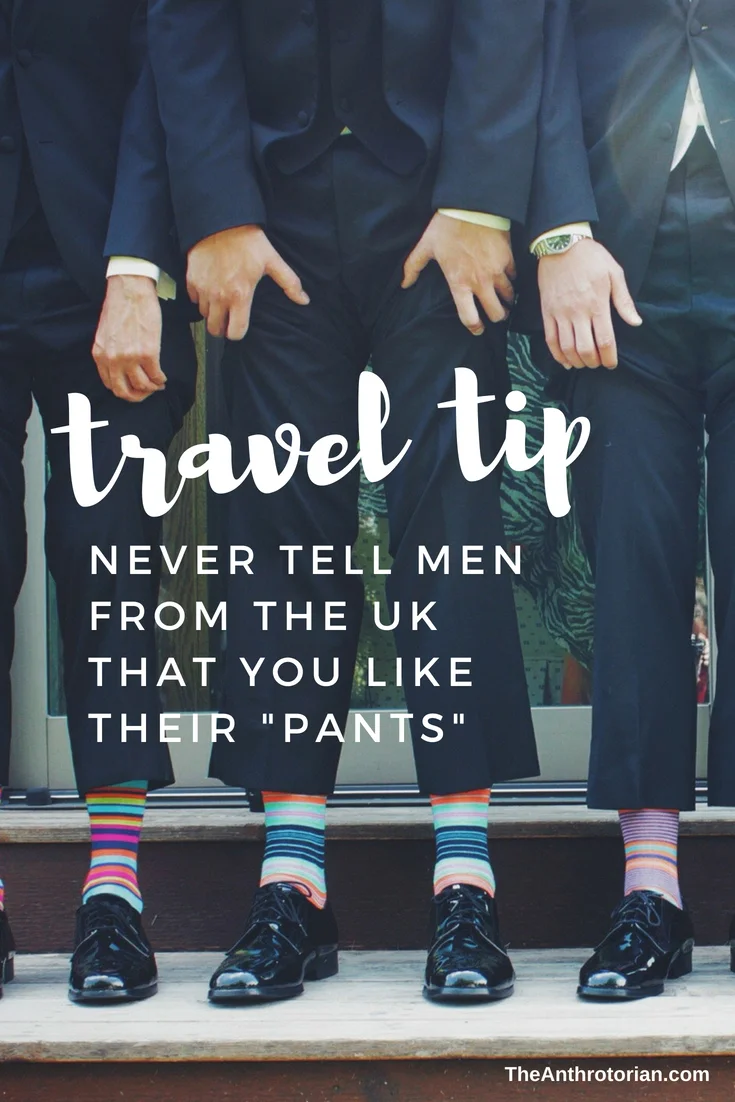
Why You Should Never Tell Men From The UK That You Like Their "Pants"

by Lindsay Shapka in , ,


I and two of my closest friends had taken the long flight from Canada to the UK (specifically York) to be the bridesmaids for our childhood pal. A fellow Canadian, she was marrying the love of her life — a ginger-haired lovable guy from Scotland. 

The days leading up to the wedding were a whirlwind of last minute shopping, events, decorating and general wedding preparations, giving very little time to get to know the Scottish/English side of the family that would be attending the wedding.

The ceremony was held in a beautiful stone building at the edge of the lush, green museum grounds, and after the "I do's" we all filtered out into the courtyard to sip champagne, and mingle. 

Embracing the chance to finally get to know some of the groom's friends and family, I approached a group of dapper looking gentlemen to introduce myself. One was wearing a pair of vibrantly colored plaid pants, and thinking that it was the perfect icebreaker, I walked up to the group and said,

"I noticed your pants from across the room, and I have to tell you that I love them! They are fantastic!"

The man to his right spit his beer out and started laughing. The one to his left covered his mouth with his hand trying to hide his amusement, while the man that I had spoken to — the one with the FABULOUS pants — just looked at me a bit wide-eyed. 

Confused at their reaction, I could feel myself turning red and said again, "Really, those are great pants!"

Now all three of them were laughing.

Really confused, and now the color of the nearby roses, I was debating running away when one of the VERY kind groomsmen leaned over from the group next to us and whispered, "In the UK, 'pants' mean underwear or panties."

Shit.

I had just told the groom's uncle that I liked his underwear.

After I closed my mouth, I turned to the laughing men and sheepishly said, "TROUSERS, I like you TROUSERS."

Then shrugging, I pointed at myself and said, "Canadian, not my fault!" and walked away in search of people who understood my own language...

Walking past a group of kilted men on the way to the bar I had an "Aha" moment, as I realized that all the groom's friends who had been telling me that they weren't wearing "pants" (duh I had thought, I can see that you are in a skirt), were actually telling me that they weren't wearing... 

Pin Me!

Never tell men you like their pants in the uk


Don't Touch The Monks in Southeast Asia!

by Lindsay Shapka in , ,


In Thailand approximately 95% of the population is Buddhist, which means that the country is chock-full of breathtaking temples (wat in Thai), elaborately carved statues of the Buddha, and saffron-coloured-robe clad monks (approx. 460,000 of them!). 

It is an expectation across the country that EVERY Thai male will become a monk for at least a short period in their life.

This practice, much like compulsory military service in countries like South Korea, usually occurs between the completion of school and the beginning of a career or marriage. It is not unusual however for males under the age of 20 to ‘take robe and bowl’ as novices, because a family earns great merit when a son becomes a monk. 

The time spent in a wat is traditionally supposed to last for three months and take place during the Buddhist version of lent that begins in July and coincides with the monsoon season.

Nowadays. however. most men spend as little as a week in the temple in order to accrue merit as a monk. 

As is the case in most organized religions, women do not have the same status as men, and are not permitted to become monks. Outnumbered by them almost 50 to 1 — I never actually saw one when I was in Thailand — these female devotees to Buddha shave their heads, wear white robes, and are called nuns. 

It is an expectation across the country that EVERY Thai male will become a monk for at least a short period in their life

The lower status of women in Buddhist practice was even more obvious to me when I learned that one of the 250 rules that monks follow is that they are not allowed to touch or be touched by women.

If you are female and want to give them alms or food, you must set the offering nearby or on their receiving cloth.

If you so much as brush against a monk on the crowded streets or water taxis of Thailand, they will have to return to the temple and perform rituals (think Silas from The DaVinci Code but less extreme) to cleanse themselves of your touch.

Pin Me!